
Rethinking early careers: What employers need to redesign in 2026
This article is a summary of a webinar discussion that took place on March 17 2026.
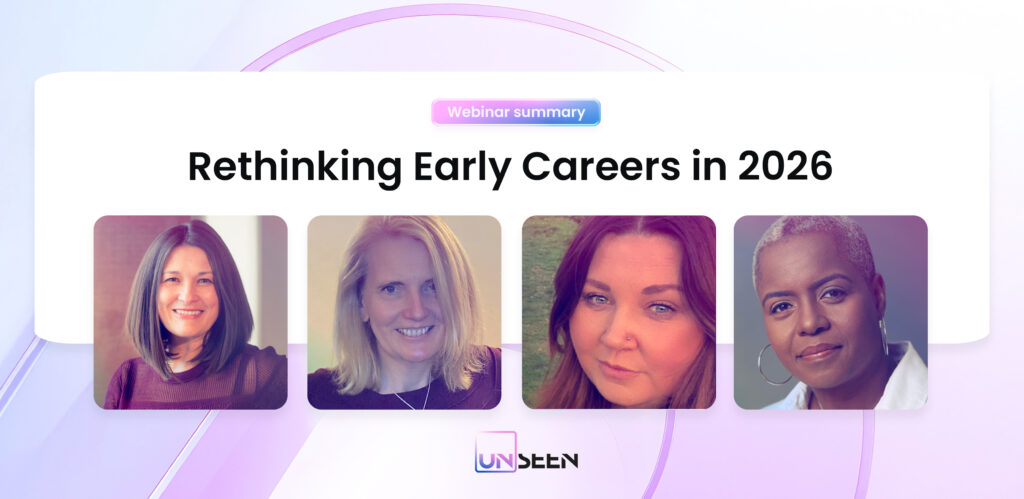
Titled Rethinking Early Careers: What needs to change in 2026, the webinar featured:
Ali Hackett, Director of Customer Experience at Unseen
Anne Marie Campion, Emerging Talent Specialist at Institute of Student Employers
Claire Monks, Graduate Programme Manager at NHS Wales
Dr Frances Trought, Founder of Everything D&I
The early careers market has always evolved, but this year feels materially different.
In our specialist early careers webinar, senior voices from across early careers, education and workforce strategy agreed that employers are now operating in a structurally different environment from just a year or two ago. 2026 is a year shaped by economic pressure, policy change, rising candidate anxiety, unprecedented application volumes and the accelerating impact of AI.
The result is a growing gap between how many organisations still recruit early talent and what candidates and businesses now need from those processes.
A more volatile market is changing how employers plan
One of the clearest themes from the discussion was that traditional annual planning cycles are becoming harder to sustain.
Rapid shifts in hiring demand, budget scrutiny, apprentice reform and wider economic uncertainty are making long-term talent planning less predictable than before. Our expert panel reflected that strategies which might once have remained stable for a year can now feel outdated within months.
That pressure is forcing employers to move beyond inherited recruitment cycles and towards more deliberate workforce planning: understanding which roles are likely to change, which skills will remain critical and where future pipelines genuinely need investment.
AI is no longer a side issue in early careers
The conversation confirmed that the debate has moved on from whether candidates should use AI, into accepting the reality that its use is prevalent.
Candidates are already using it, employers are using it, and trying to remove it from recruitment entirely is increasingly unrealistic.
The more important challenge now is how organisations respond fairly and intelligently.
This includes:
- Deciding where AI use is acceptable in applications
- Understanding how it affects assessment validity
- Addressing unequal access to paid AI tools
- Distinguishing between assisted responses and genuine judgement
Several speakers noted that many established selection methods are becoming less effective in this context. Generic written answers, CV screening and predictable competency questions are now easily generated or strengthened through AI.
The implication is not to remove rigour, but to redesign it, placing greater weight on judgement, authenticity and live interaction.
Rethink assessment for a changing candidate landscape
As traditional screening methods become less effective, assessment needs to reflect how people think, solve problems and respond in real situations. Our Digital Assessment Centre platform, TopScore, helps employers assess potential more fairly and consistently.
Explore Digital Assessment Centre solutionsAssessment needs to reflect real working life
A strong consensus emerged that assessment processes need to become more representative of how people will actually work.
If AI will be part of day-to-day working environments, then excluding it entirely from recruitment creates an artificial test.
Instead, employers should increasingly assess:
- How candidates think
- How they solve problems
- How they apply judgement
- How they use tools responsibly
That points towards more situational tasks, more project-based exercises and more live interaction, particularly later in the process.
At the same time, panellists acknowledged the practical tension this creates: face-to-face assessment and richer interaction often require more resource at a point when many teams are being asked to deliver more with less.
The confidence gap is now a major recruitment issue
One of the most important insights from the webinar was that candidate behaviour is being shaped not only by competition, but by confidence.
Across sectors, employers are seeing:
- Higher anxiety
- Lower certainty
- Greater fear of rejection
- Increased disengagement between offer and start date
For many young people, repeated rejection is no longer just part of the process but an experience that it is affecting confidence in education choices, career direction and whether they belong in professional environments at all.
That means candidate experience is no longer a secondary consideration. It has become central to conversion and retention.
Several speakers argued that employers need to think much more carefully about:
- How rejection is handled
- Where clarity is missing
- How transparent entry requirements really are
- Whether candidates understand what is expected of them
Even simple improvements in communication can materially change outcomes.
Build confidence before day one
When candidates feel informed, connected and reassured, they are more likely to stay engaged throughout the journey. Unseen’s Candidate Experience & Onboarding platform, Meet & Engage, helps employers create stronger touchpoints before offer, after offer, and through onboarding.
Explore Meet & EngageHuman connection matters more than ever before day one
A particularly strong theme was that organisations often underestimate how fragile the period between offer acceptance and start date has become.
This is where doubt grows, competing offers strengthen, and silent drop-off happens.
What prevents that is rarely process alone. It also about relationships and authenticity.
The most effective examples shared all involved stronger human contact:
- Manager introductions
- Buddy relationships
- Early cohort engagement
- Invitations to informal events
- Clearer onboarding support
- Practical visibility of what the first weeks will look like
As one panellist put it, organisations that retain talent best are often those that continue recruiting candidates emotionally right up until day one.
Skills-based thinking must go further
Another major point was that many organisations still talk about skills-based hiring more than they fully practise it.
Rigid academic filters, narrow qualification assumptions and institutional bias can still close off talent unnecessarily.
The panel challenged employers to think more carefully about aptitude, transferable capability and demonstrated potential – particularly where future roles are changing quickly anyway.
This matters not only for fairness, but for long-term talent resilience.
If organisations continue selecting only through familiar indicators, they risk reproducing the same talent profiles while missing the wider capabilities increasingly needed in a changing market.
Education and employers need closer alignment
A repeated concern was the widening disconnect between what education systems are producing and what employers expect.
Universities, schools and colleges are under pressure themselves, often being asked to support more students with fewer resources.
At the same time, employers continue to expect stronger work-readiness, AI fluency, data literacy and commercial understanding.
The discussion suggested that solving this cannot sit with one side alone. More partnership is needed:
- Earlier exposure to employers
- More meaningful insight experiences
- Micro-internships and challenge-based learning
- Stronger collaboration around future skill needs
The strongest examples are those that help young people understand work before formal application begins.
The strategic shift for employers
Taken together, the discussion pointed to a clear conclusion:
The organisations likely to succeed in early careers now will be those that stop treating recruitment as a fixed annual process and start treating it as a connected talent system – one that combines planning, assessment, communication, development and belonging.
The external pressures are unlikely to ease soon.
But many of the strongest responses are within employers’ control:
- Simplify where complexity adds little value
- Redesign outdated assessment steps
- Build trust earlier
- Communicate more clearly
- Create stronger bridges between attraction and retention
In a market where candidates have more uncertainty and employers have less margin for error, the organisations that feel most human are often the ones that perform best.
Hear the full discussion
This article captures some of the key themes from the conversation, but the full webinar explores the practical challenges, audience questions and panel perspectives in much greater depth.
Watch the webinar on demand